
STEP 01
Optical Framing
The system guides face positioning within the central camera frame, discarding background clutter and isolating only the region required for verification.
AreaFACE is the official facial verification and operational presence engine powering Areatec products. It confirms whether the person in front of the camera matches the reference image bound to their credential, converting the optical reading into an ultra-compact 256-byte (16×16 pixel) mathematical signature with pre-enrollment lighting validation and native human review support.
The purpose of AreaFACE is to verify real human presence in front of the device. Therefore, this workbench only unlocks reference enrollment and access testing after your live camera is enabled.
Engineered to run across web browsers, field mobile devices, and service desks without requiring proprietary cameras.
The system guides face positioning within the central camera frame, discarding background clutter and isolating only the region required for verification.
Before comparing, the engine measures luminance and contrast. If the room is too dark or backlit, the user is immediately guided to retake the capture.
The live 256-byte optical signature is compared strictly against the holder's enrolled reference, compensating for natural ambient brightness shifts.
Once the security threshold is met, access is granted and sealed in the audit trail. Inconclusive captures are routed to supervisor-assisted review.
AreaFACE solves the critical gap where passwords or physical badges can be shared: proving who is physically in front of the terminal.
As the official biometric engine across Areatec platforms, it confirms the live presence of field agents, inspectors, and operators at shift start or command-center sign-in, ensuring every system action is tied to the authenticated professional.
Compares the live service capture against the account's reference profile, preventing duplicate registrations and identity impersonation.
Adds sub-millisecond facial verification before approving reports, unlocking administrative privileges, modifying critical records, or dispatching equipment.
Instead of blocking service when harsh lighting affects the camera, it structures optical telemetry so a supervisor can review and authorize the event with a formal audit record.
Engineered by Areatec to deliver mathematical determinism, extreme lightness, and data governance where generic engines fail due to GPU cost or black-box opacity.
| Architecture | What Is Captured & Stored | Matching & Lighting Method | Required Infrastructure | Governance & Purpose |
|---|---|---|---|---|
| AreaFACE (Official Areatec Engine) | 16×16 Luminance Matrix (256 Bytes) extracted from a 160×160 center crop with zero raw photo retention. | Zero-Mean Cosine (≥ 84%) preceded by an optical gate weighting contrast (70%) and light (30%) with a 32% floor. | Ultra-Light Execution (Pure CPU / Edge / Web) in microseconds, with zero GPU servers required. | Strict 1:1 Verification: matches only the holder's reference, sealed with PinTrust & AreaChain. |
| Conventional Neural Engines (1:1 / 1:N) | High-resolution photographs (2 to 5 MB) and opaque high-dimensional tensors stored in the cloud. | Black-box inference vulnerable to harsh side shadows when client-side optical gating is absent. | Dedicated high-cost GPU servers and higher network payload latency per call. | Larger exposure surface of raw biometric images and high cloud storage overhead. |
| Open-Crowd 1:N Search Engines | Continuous scanning of multiple faces in video streams against databases of thousands or millions of faces. | Probabilistic Top-K candidate ranking prone to false positives as gallery size grows. | Real-time video processing clusters and dedicated surveillance cameras. | Unsuitable for nominal service-desk access, shift check-in, or strict 1:1 credential validation. |
While legacy engines transmit and store 2,500,000-byte photos, AreaFACE synthesizes a 256-byte matrix (344 Base64 chars) — a 9,765× payload reduction per person.
One hundred thousand enrolled references in AreaFACE occupy only 25.6 MB, fitting entirely inside a standard CPU L3 cache — compared to 250 GB in traditional storage architectures.
The 256-dimensional Zero-Mean Cosine calculation resolves in tens of microseconds on standard CPUs, exceeding 50,000 verifications per second per core without GPU hardware costs.
The 160×160 RGB crop (76,800 bytes) undergoes a one-way 300:1 spatial reduction to 256 bytes, making it mathematically impossible to reconstruct a human photo during external audits.
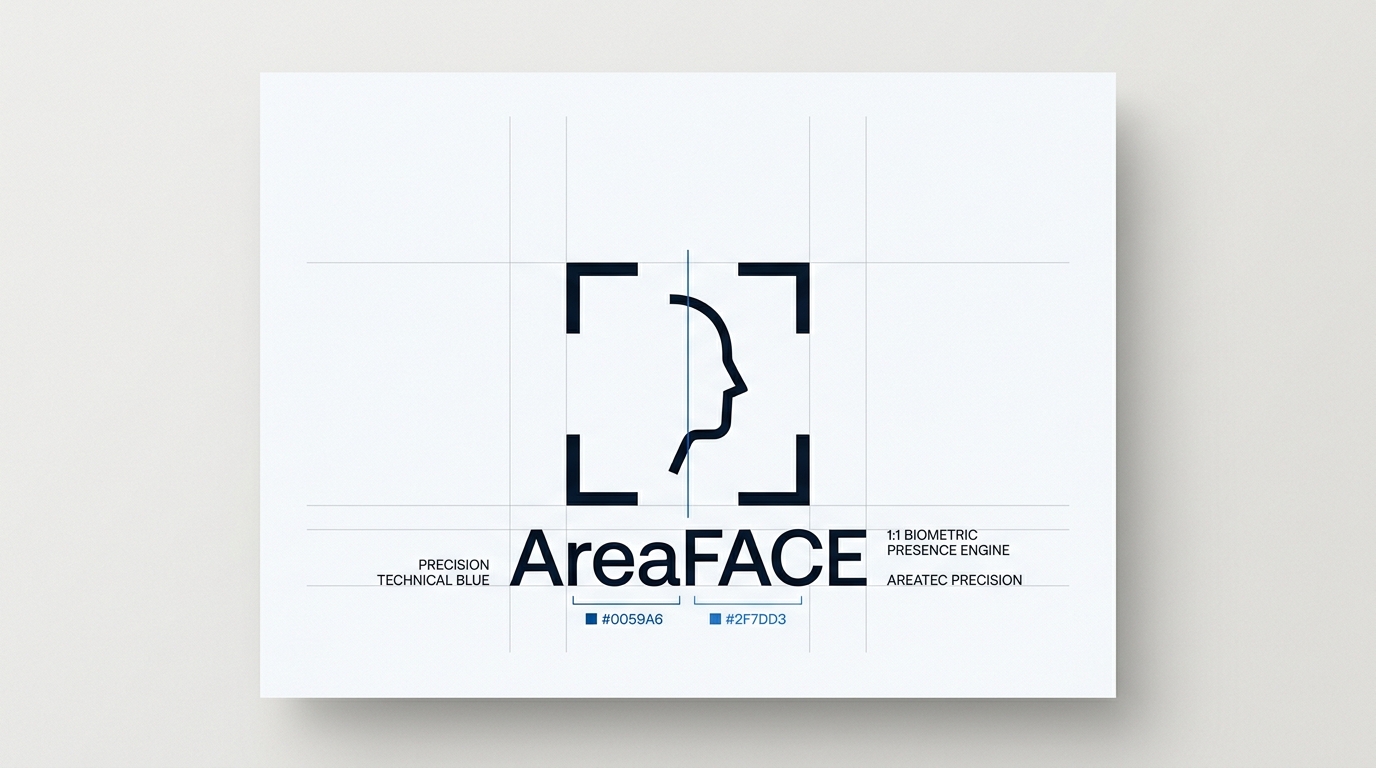
The AreaFACE brand and architecture reflect its function: four optical framing brackets define the controlled capture zone (160×160), while the vertical axis represents the direct 1:1 comparison between the reference baseline (256 bytes) and live human presence.
Across Areatec Tecnologia mission-critical solutions, AreaFACE operates in native synergy with PinTrust and AreaChain to establish an unforgeable proof of physical, geographic, and temporal presence:
Proves the person in front of the camera matches the enrolled 256-byte reference matrix via Zero-Mean Cosine Similarity.
Uses modern physical signal-integrity verification techniques to guarantee recorded latitude and longitude are authentic and not forged via GPS spoofing.
Chains the facial verification seal and authentic geolocation into a tamper-evident cryptographic ledger (SHA-256).
 Official facial verification and presence engine of Areatec products
Processing biometric data requires shared responsibility between the engine's technical privacy-by-design safeguards and the deploying organization's legal governance.
16×16 irreversible numerical matrices (ISO/IEC 24745 aligned), avoiding raw photo or video retention.We do not use rigid public price tiers or charge blindly for poorly lit frames. Every proposal is scoped directly with our engineering team based on deployment topology and institutional scale.
For municipalities, public agencies, and operations already running or procuring official Areatec Tecnologia platforms.
For enterprises, government portals, and custom software teams embedding ultra-light 1:1 facial verification (256 bytes) into their workflows.
< 32%) are not billed.For public agencies, security forces, and large enterprises requiring 100% execution inside their own data center or isolated private cloud.
< 0.05 ms per match; 25.6 MB RAM per 100k users).Legacy biometric vendors charge steep flat fees because they must fund expensive cloud GPU clusters and terabytes of raw image storage. With AreaFACE, a municipal service desk, field shift check-in, or enterprise portal each have distinct operational profiles. By completing the 3-phase briefing below, our engineering team evaluates your exact scenario to deliver a lean, right-sized commercial proposal.
Technical and operational answers for engineering teams, public-sector leaders, and Data Protection Officers (DPOs).
AreaFACE is the official 1:1 facial verification and biometric presence engine powering products developed by Areatec Tecnologia. It solves the need to rapidly and auditably confirm whether the person physically in front of the camera is the true holder of a specific credential or record — preventing password sharing in critical systems and ensuring authentic access to operational modules.
While conventional engines upload heavy multi-megabyte photographs (2 to 5 MB) to GPU servers, AreaFACE performs a 160×160 central optical crop and synthesizes it into a 16×16 luminance structural matrix (exactly 256 bytes). Before enrolling a reference or validating access, it evaluates contrast standard deviation (70% weight) and luminance balance (30% weight), enforcing a 32% quality floor, and applies Zero-Mean normalization to Cosine Similarity (≥ 84% threshold) in under 0.05 ms on pure CPU.
In a 1:N search engine, a camera captures an unknown face and scans an entire database trying to guess who that person is. In AreaFACE (1:1 verification), the user is already identified in the workflow and the engine compares the live capture strictly against that specific person's reference baseline. This drastically reduces false positives, protects privacy, and enforces strict purpose limitation.
Across Areatec platforms, the three modules form an operational trust triad: AreaFACE confirms 1:1 biometric identity in front of the camera (Who), PinTrust uses modern signal-integrity verification techniques to guarantee recorded latitude and longitude are authentic and free from GPS spoofing (Where), and AreaChain seals the event into an immutable SHA-256 cryptographic ledger (Proof).
Before comparing facial topology, AreaFACE computes an optical quality score based on lighting and contrast. If the frame is too dark, overexposed, or blurry (below 32%), the engine immediately prompts the user to adjust lighting, preventing poor frames from causing false lockouts. If a capture remains in the intermediate zone, it is routed to supervisor human review.
AreaFACE pricing is provided exclusively through technical and commercial consultation, as its 256-byte pure-CPU architecture eliminates cloud GPU servers and heavy image storage overhead. Licensing is structured in three modalities: (1) Bundled natively within Areatec Tecnologia product contracts; (2) REST API & SDK licensing tailored to active enrolled users or verification volume; and (3) Dedicated On-Premise or GovCloud deployments for public-sector agencies and large enterprises.
AreaFACE can be embedded directly into modern web and mobile applications (including C# .NET / Blazor and JavaScript/WebRTC) or consumed via REST API, keeping verification and audit records synchronized with your institutional database.
Complete the 3-phase briefing wizard on the right. Our algorithm automatically sizes your operation, dispatches an interactive technical dossier to your inbox, and routes your inquiry directly to Areatec's engineering leadership.
We structure Areatec's technical intake in three phases so our algorithm automatically sizes your architecture and dispatches a tailored executive briefing to your inbox and our engineering leadership.